
Most small business owners treat taxes like a dentist appointment; they ignore them all year, then panic when the date arrives. I get it. But the businesses that consistently owe less at filing aren’t doing anything magic. They’re just playing the game year-round instead of cramming the night before.
If you apply the right year-round small business tax strategies, you stop reacting and start winning. Here’s how.
Don’t wait until Q4 to think about taxes. Track deductions monthly, pay estimated taxes quarterly, time your purchases and income deliberately, and maximize retirement contributions. Do this all year and your filing bill shrinks dramatically.
Why Proactive Tax Management Changes Everything
Think of your tax bill like a leaky faucet. One drip at a time doesn’t seem catastrophic but by April, you’re standing in a flood wondering what happened.
The goal is to move from reactive compliance to proactive advantage, using tax planning as a year-round driver for performance.
That’s not just consultant-speak. It’s the difference between owing a painful lump sum and filing with confidence.
Think of quarterly tax planning as your business’s financial health check-up. Instead of scrambling during tax season, regular monitoring helps you make proactive decisions that can significantly impact your bottom line.
The good news? You don’t need a CFO on staff. You need a system and these strategies.
Master Your Quarterly Estimated Tax Payments
Let’s start with the move that saves you the most immediate pain: actually paying your estimated taxes on time.
Unlike traditional employees who have taxes automatically withheld from each paycheck, small business owners and self-employed individuals are responsible for paying their own taxes four times per year.
Miss a payment and the IRS sends you a penalty. Not a strongly worded letter. An actual financial penalty.
If you expect to owe more than $1,000 in federal taxes for the tax year, you may need to make estimated quarterly tax payments using Form 1040-ES, or else face a penalty for underpayment.
Here’s my practical system: set aside 25% to 30% of profit each time you get paid, and move it into a separate savings account labeled “taxes.”
It sounds almost too simple. But it works because the money is gone before you can spend it on something else.
If your income fluctuates, adjust that percentage up or down as revenue changes, or base it on last year’s tax bill to stay within the IRS safe harbor rules.
Also worth knowing: if you estimated your earnings too high, simply complete another Form 1040-ES worksheet to refigure your estimated tax for the next quarter. If you estimated too low, do the same thing.
It’s not locked in. Adjust as you go.
Reduce Taxable Income With Smart Deduction Tracking
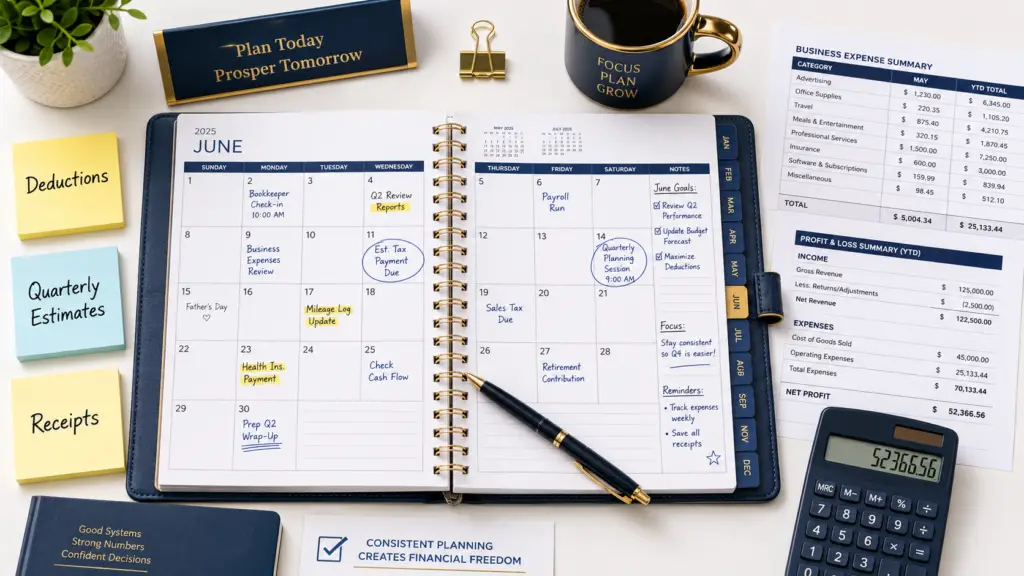
Here’s a wild idea: track your deductible expenses throughout the year instead of doing archaeological digs through your bank statements in March.
Ten common write-off categories directly reduce taxable income track them year-round. Keep clear records: receipts, logs, and separate accounts for audit readiness.
The categories worth watching closely include home office, mileage, software subscriptions, health insurance premiums, and professional services.
Deductions lower your taxable income, while credits reduce your tax bill dollar for dollar often yielding even greater savings.
That distinction matters. A $10,000 deduction is worth a percentage of its face value. A $10,000 credit? That’s $10,000 off your actual bill.
One deduction I see small business owners chronically under-use: self-employed individuals can generally deduct 100% of their health insurance premiums for themselves, their spouse, and dependents, including health, dental, vision, and long-term care insurance coverage.
And don’t overlook business meals.
Most business meals, including those provided during in-office meetings, conferences, and business travel, are still 50% deductible.
That’s not nothing. Document the business purpose every time because “lunch” is not a business purpose.
Use Deduction Timing Strategies to Shift Your Tax Burden
Timing isn’t just for comedy. It’s one of the most underrated tools in proactive tax management.
One reliable tax-saving strategy is to accelerate expenses and defer income. If you have bills to pay, supplies to buy, or equipment you’ve been eyeing, consider making those purchases before December 31.
On the income side, if you’re expecting payments from clients, you might be able to delay sending invoices until January. That way, the income hits your books next year, potentially reducing your taxable income for the current year.
Cash flow comes first, obviously. But if you have flexibility, this is a legitimate and legal way to manage your taxable income.
On the equipment front, there’s big news worth knowing.
Thanks to the One Big Beautiful Bill Act (OBBBA) signed into law in July 2025, 100% bonus depreciation has been permanently reinstated, meaning that eligible businesses can immediately deduct the full cost of qualifying new and used assets in the year they are put into service.
That’s a meaningful change from recent years.
Timing matters: place assets in service before December 31 to secure current-year tax deductions.
Don’t buy the equipment in January hoping it counts for last year. It doesn’t.
Max Out Retirement Contributions to Slash Taxable Income
This is the strategy that does double duty it builds your future wealth *and* reduces taxable income small business owners would otherwise hand straight to the IRS.
Business owners can reduce taxable income and build personal wealth through retirement contributions.
A Solo 401(k) is one of the most powerful vehicles available.
In 2025, you may be able to contribute up to $70,000 to your Solo 401(k). Additionally, the limit increases by an extra $7,500 if you’re 50 to 59 or 64 or older through a catch-up contribution.
And don’t sleep on Health Savings Accounts either.
HSAs remain one of the most tax-efficient savings tools available. Contributions are pretax, earnings grow tax-free, and withdrawals for qualified medical expenses are tax-exempt.
Triple tax advantage. I’ll take it.
Don’t Forget the QBI Deduction
If you’re a pass-through entity sole proprietor, LLC, S-corp, partnership this one’s for you.
The Qualified Business Income (QBI) deduction, also known as the 20% pass-through deduction, remains one of the most valuable benefits for small business owners. It allows eligible sole proprietors, partnerships, and S-corp owners to deduct up to 20% of qualified business income from taxable income.
Even better: the 20% deduction is now permanent.
You don’t have to worry about it expiring. But you do need to know if you qualify generally, if your taxable income is under $197,300 for single filers or $394,600 for joint filers in 2025, you may qualify.
FAQ: Year-Round Small Business Tax Strategies
Q: How often should I actually review my taxes throughout the year?
At minimum, quarterly ideally monthly.
Regularly reviewing income and expenses lets you adjust your estimated taxes as needed and catch deductions before they slip through the cracks. Monthly reviews take 30 minutes. April surprises take much longer to recover from.
Q: What’s the safest way to avoid underpayment penalties?
If your federal income tax withholding plus any timely estimated taxes you paid amounts to at least 90% of the total tax that you will owe for this tax year, or at least 100% of the total tax on your previous year’s return, you’re covered.
That second option matching last year’s bill is the easier calculation for most business owners.
Q: Should I hire a tax professional or use software?
Both have a place.
The key is matching the solution to your business’s complexity and your comfort level with tax matters. Sometimes a hybrid approach works best: using software for day-to-day tracking and consulting professionals for strategy and complex filings.
If your business has employees, multiple income streams, or you’ve had a major change this year, a CPA is worth every dollar.
Build Your Year-Round Tax System Starting Now
Here’s the honest truth: most businesses don’t have a tax problem, they have an organization problem. The deductions exist. The strategies work. But you can’t use what you didn’t document.
Adopt a year-round routine: plan purchases and contributions, log miles, and keep receipts.
Set a recurring calendar reminder each month to review expenses and categorize everything. And if you’re still running business expenses through a personal account, stop.
The IRS recommends keeping separate accounts for business and personal expenses. If you don’t, it may be harder to accurately estimate your quarterly payments, and you may have difficulty if you are audited.
The businesses that file with confidence aren’t smarter than you. They’re just more consistent. Apply these year-round small business tax strategies and you’ll walk into next filing season with fewer surprises and a smaller check to write.
Ready to take control of your taxes before they take control of you? Start by reviewing last year’s return with Gina Webb and identifying which strategies you didn’t use. That gap is money left on the table. Go get it back