
If you’ve ever Googled “bookkeeping cost small business” and ended up more confused than when you started, you’re in good company. The answers online range from “totally cheap!” to “prepare your wallet.” So let’s cut through the noise and give you real numbers, real context, and zero jargon.
Most small businesses pay between $200–$600 per month for bookkeeping services, while mid-sized companies can expect $2,500+ monthly depending on transaction volume and complexity.
The exact number depends on how you hire, what you need, and where you’re located. Read on for the full breakdown.
What Does Bookkeeping Actually Cost for a Small Business?
Here’s the honest answer: it depends. I know, I know not the crisp number you were hoping for. But think of it like asking “how much does a car cost?”
The answer depends on whether you’re talking about a used sedan or a brand-new luxury SUV. The same goes for bookkeeping.
That said, we can absolutely give you a solid ballpark.
Small businesses should expect to pay around $300 or more each month for bookkeeping. But prices range dramatically.
Based on service type and complexity, monthly bookkeeping costs can range from $500 to $10,000. Part-time bookkeepers typically charge between $21 and $23 per hour, making them a flexible option for small businesses.
The good news? Most small businesses sit comfortably at the lower end of that range especially when they choose the right pricing model.
The 3 Main Bookkeeping Pricing Models
Understanding how bookkeeping is priced is half the battle. There are three main structures you’ll encounter, and each has its own sweet spot.
1. Hourly Rates
This is the classic “pay as you go” approach.
Most bookkeepers charge $30 to $100 per hour, depending on experience and state.
Junior bookkeepers might charge $25/hour, but senior accountants with tax planning expertise often exceed $75/hour.
Hourly works well if your needs are occasional and unpredictable. But fair warning if your books are a bit of a mess (no judgment), those hours can add up fast.
2. Flat Monthly Packages
This is where most small businesses land, and honestly, it’s my favorite model for peace of mind.
Flat fees are common among online bookkeeping services. For that fixed price, you’ll get a set list of tasks. Most packages range anywhere from around $200 per month to $700 and up.
Flat-rate bookkeeping gives you predictable pricing with no hidden charges, making it the most scalable option for growing businesses.
Think of it as the Netflix subscription of your financial life. You know exactly what you’re paying every month.
3. CPA Firm Rates
Need specialized tax help layered in? CPA firms charge a premium.
CPA firms typically charge $100–$250/hour for specialized or tax-related work.
Worth it for complex situations, but probably overkill if you just need the basics handled cleanly.
What Factors Drive Your Monthly Bookkeeping Fees Up (or Down)?
This is where it gets personal. Your bookkeeping bill isn’t random; it’s shaped by some very specific things about your business.
Transaction Volume
A big one is how many transactions you have each month. If you’re running a small consulting firm with just a few invoices and expenses, the work is lighter. A retail shop with hundreds of sales and vendor payments, on the other hand, takes much more time to reconcile.
Business Complexity
Complexity matters too. Do you run payroll? Track inventory? Operate across multiple states or with several bank accounts? Each layer adds steps for your bookkeeper and pushes the fee higher.
Scope of Services
Some bookkeepers simply categorize transactions and produce monthly reports. Others handle accounts payable, tax prep, or even advise you on cash flow. Naturally, a broader scope brings a higher bill.
Your Location
Geography matters more than you’d think.
Higher-cost states like California, New York, New Jersey, Massachusetts, Washington, and Connecticut consistently show the highest pay for bookkeeper states with large metros, higher costs of living, and tight labor markets.
Places like Alabama, Arkansas, Mississippi, West Virginia, and South Dakota come in lowest.
Software Use
Using accounting software like QuickBooks Online, Xero, or Wave can reduce manual hours, lowering your monthly fee.
Basically, the more automated your setup, the less time your bookkeeper spends on grunt work and the less you pay. Win-win.
Freelancer vs. Firm vs. Full-Time: Which Is Right for You?
Choosing your provider type is just as important as understanding the price tag. Here’s a quick rundown of your options:
Freelancers are cost-effective for startups needing part-time help.
They’re flexible and usually the most affordable bookkeeping services option, especially early on.
Bookkeeping firms offer team-based support, scalability, and advanced software toolsideal for small and mid-sized businesses.
You get a whole squad instead of one person, which is great if you’re growing quickly.
Full-time bookkeepers fit best for high-volume operations needing daily management of invoices, payroll, and reconciliations.
This is the costliest route but makes sense if your books are practically a full-time job on their own.
And then there’s the modern option: outsourced online services.
Most small businesses today prefer using an online bookkeeping service, not only because it’s more affordable but because it gives them real-time financial visibility without hiring an in-house team.
I’d call it the “hire a whole team for the price of one freelancer” approach and it’s hard to argue with that math.
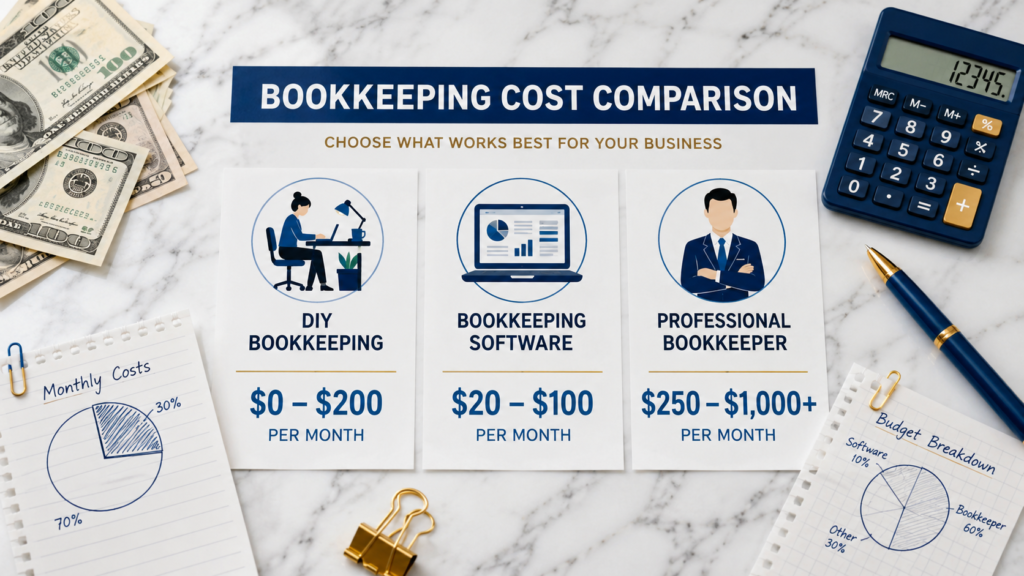
Bookkeeping Pricing Packages: What’s Typically Included?
When comparing bookkeeping pricing packages, you’ll generally find three tiers. Think of them like a menu appetizer, entrée, and the full tasting menu.
Basic packages ($150–$400/month) usually cover transaction recording, bank reconciliations, and basic monthly reports. Great for solopreneurs and early-stage businesses.
Mid-tier packages ($400–$800/month) add accounts payable/receivable management, payroll support, and more detailed reporting.
Full-service packages ($800–$2,500+/month) include everything above plus CPA review, cash flow analysis, and tax coordination.
Complex setups run $1,500 to $2,500+ when controller review is layered in.
Modern bookkeeping isn’t just about balancing booksmany professionals offer add-on services that impact pricing. Bundling these services can reduce your total cost if you negotiate a package deal.
How to Find Affordable Bookkeeping Services Without Sacrificing Quality
Affordable doesn’t have to mean barebones. Here are a few smart moves I’d recommend:
First, use cloud-based software to reduce manual work.
Automated bookkeeping tools like QuickBooks Online, Xero, and Wave can help you cut costs by reducing the need for manual data entry. Many bookkeeping services integrate with these platforms, allowing you to get professional support while keeping expenses low.
Second, consider industry-specialized services.
Some bookkeeping firms specialize in working with businesses in specific industries, such as retail, healthcare, or construction. These specialized services often provide tailored solutions at competitive prices, ensuring that you only pay for the services that are relevant to your business.
Third, remember the tax perk.
The IRS allows bookkeeping and accounting expenses to be deducted as administrative business costs, which reduces your taxable income at year-end.
So that monthly fee stings a little less come tax time.
And finally, focus on value, not just price.
The point isn’t to chase the lowest price but to match the cost with the value.
A $200/month service that keeps your books spotless is worth far more than a $100/month mess you’ll pay your CPA triple to clean up.
FAQ: Bookkeeping Cost for Small Businesses
Q: What is the average monthly bookkeeping cost for a small business?
On average, outsourced bookkeeping services range from $300 to $2,000 per month, depending on the size of your business, the number of monthly transactions, and the services you need.
For most lean operations, you’ll land somewhere in the $300–$600 range.
Q: Is it cheaper to hire a freelance bookkeeper or use an online service?
Freelancers are usually cheaper ($30–$60/hr), while firms provide more resources and expertise but cost more. Online platforms often start at $200/month, making them affordable for small businesses with simple needs.
The right answer depends on your volume and how hands-on you want your support to be.
Q: Can I reduce my bookkeeping costs by using accounting software myself?
Absolutely and many business owners do exactly this, at least in the early days.
Some cloud-based software even offers built-in bookkeeping features that eliminate the need for a dedicated bookkeeper.
That said, once your business grows, DIY bookkeeping tends to cost more in errors and lost time than it saves.
Budget Smart, Book Well
Understanding the bookkeeping cost for your small business isn’t just a financial exercise, it’s a step toward running a tighter, smarter company. Whether you’re a solopreneur with a handful of monthly invoices or a growing team juggling payroll and inventory, there’s a pricing model out there that fits.
Start by knowing your transaction volume, your complexity, and your budget. Then match those to the right provider type and package level. And remember clean books aren’t just a nice-to-have. They’re what make tax season survivable and growth decisions possible.
Ready to stop guessing and start knowing exactly where your money goes? Reach out to us at Gina Webb Accounting today and schedule a free, no obligation, consultation. Your future self, the one who breezes through tax season will absolutely thank you.