
Freelancing is many things liberating, exciting, occasionally chaotic but “cheap” isn’t usually on the list. That’s why knowing the right tax deductions for freelancers and solopreneurs can genuinely change your financial picture. And I mean that. We’re talking real money staying in your pocket instead of disappearing into the IRS void.
The good news? The IRS offers freelancers a generous array of deductions that directly reduce taxable income. Unlike employees who can only deduct certain expenses above a threshold, freelancers report on Schedule C making every legitimate business expense a potential dollar off your tax bill.
Let that sink in for a second.
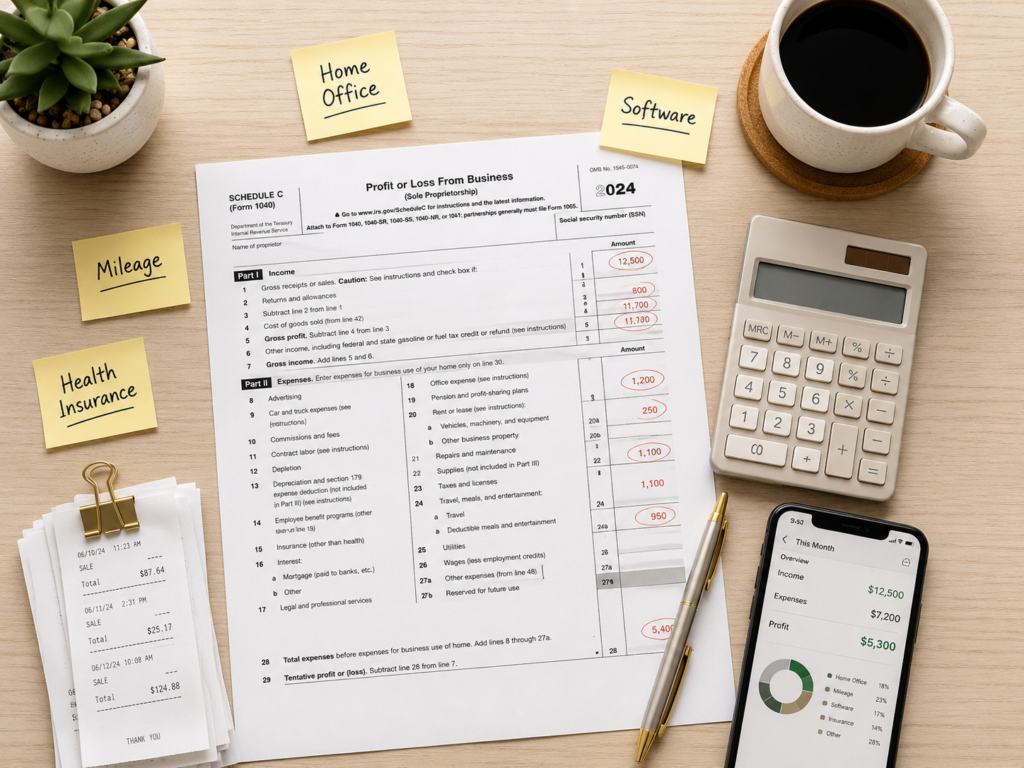
As a freelancer or solopreneur, you can deduct your home office, business mileage, health insurance premiums, retirement contributions, software, equipment, and more all on Schedule C. Track everything, and you could dramatically cut what you owe at tax time.
Why Most Freelancers Leave Money on the Table
Here’s a scenario I see all the time: a talented solopreneur hustles all year, lands great clients, earns solid income then hands over a painful chunk of it at tax time because they didn’t track their deductions. It’s like leaving your wallet on the counter at a restaurant. Painful, preventable, and very avoidable.
It’s easy to miss expenses that qualify as business deductions because the tax code is complex and constantly shifting. That’s why it pays to stay aware of changes and work with a tax professional who can help identify additional opportunities to reduce your taxable income.
The deductions below are your starting lineup. Let’s get into them.
The Home Office Deduction Your Living Room Might Be Worth Money
If you work from home (and most of us do), the home office deduction is your best friend.
To qualify, you must use part of your home regularly and exclusively for business, and it must be your principal place of business.
Notice the word *exclusively* your kitchen table where you also eat breakfast doesn’t count. Sorry.
You choose between the Simplified Method ($5/sq ft × up to 300 sq ft = max $1,500) or the Regular Method (actual expenses × business-use percentage). The regular method can yield a larger deduction but requires more documentation.
Audit scrutiny remains high especially for large claims or “flexible” spaces like dining rooms or guest rooms. The home office must relate to self-employed or 1099 work you can’t claim for hybrid W-2 remote work.
So if your employer also has you working from home, that portion doesn’t qualify. Keep it clean and documented.
Mileage Deduction for the Self-Employed Those Miles Add Up
Think driving to a client meeting or the office supply store doesn’t matter? Think again.
Even if you only make short trips for work, tracking your mileage throughout the year can add up to significant deductions. You can deduct mileage at the IRS standard rate and transportation costs for business activities such as mileage for client meetings, conferences, and project work.
The standard mileage rate for the first half of 2026 is 72.5¢ per mile driven for business.
That’s genuinely generous to drive 5,000 business miles and you’re looking at a $3,625 deduction before you’ve even thought about anything else.
Whether you use the standard mileage rate or actual expenses, consistency matters in tracking your mileage so consider using an app to track it accurately and make it easier to have the data at hand when you need it for filing your return.
A mileage app takes about three seconds per trip. Three seconds now versus losing thousands at tax time? Easy math.
Self-Employed Health Insurance Deduction A Big One
This is the deduction that makes people’s jaws drop when they realize they’ve been missing it.
Self-employed workers can deduct 100% of health insurance premiums for themselves, their spouse, dependents, and children under 27. This covers medical, dental, and vision. This deduction goes on Schedule 1 of Form 1040, reducing adjusted gross income directly.
That’s an “above the line” deduction meaning it lowers your AGI even if you don’t itemize. It’s one of the most powerful moves in the freelance tax playbook.
You must not be eligible for employer-sponsored coverage through your own employer or a spouse’s
to claim this one. But if you’re fully self-employed and buying your own coverage? You’re almost certainly eligible. Check with your CPA to confirm.
Retirement Contributions Save Now, Pay Less Later
Here’s one I truly love recommending, because it’s a double win: you build your future wealth *and* reduce your tax bill today.
You can contribute pre-tax to a Solo 401(k) (up to $69,000 in 2025 including employer and employee contributions), a SEP-IRA (25% of net self-employment earnings), or a SIMPLE IRA. These reduce taxable income dollar-for-dollar and build your retirement nest egg simultaneously.
And if you’re 50 or older, there’s even more room.
For 2025, you can contribute up to $23,500 in pre-tax earnings to a 401(k) plan, plus an additional $7,500 if you’re 50 or older.
Stacking a retirement contribution on top of your other deductions is one of the smartest moves a solopreneur can make.
The 1099 Write-Offs You Might Be Overlooking
Beyond the big four above, there’s a whole shelf of solid 1099 write-offs that most freelancers underuse.
As a 1099 worker, you can write off any ordinary and necessary business expense: home office, vehicle and mileage, health insurance premiums, retirement contributions, business travel, equipment, advertising, professional development, business meals (50%), legal and accounting fees, business insurance, supplies, and cell phone/internet.
A few highlights worth calling out specifically: Software & Tools: Software subscriptions like Adobe or Microsoft 365 and AI bookkeeping apps are fully deductible in the year paid if used more than 50% for business.
If you’re paying for Notion, Figma, or any project management tool that’s a write-off.
Equipment: Computers, monitors, smartphones, cameras, and other devices used for work are deductible based on their business-use percentage.
Buy that new laptop, track the usage, and deduct accordingly.
Professional Services: Accounting, legal services, virtual assistants, AI tax research tools, and project-management services anything ordinary and necessary for your trade are fully deductible.
The Qualified Business Income (QBI) Deduction Don’t Skip This
This one flies under the radar but deserves a spotlight.
The Qualified Business Income (QBI) deduction may allow eligible freelancers to deduct up to 20% of their net business income from sole proprietorships, partnerships, or S corporations. For 2026, this deduction typically begins to phase out when taxable income is above $200,900 for single filers or $401,800 for joint filers.
If you’re within those thresholds, that’s a potentially massive deduction that requires zero extra spending.
Calculate QBI using your Schedule C or K-1.
And yes, absolutely loop in a tax professional here the rules have nuances worth navigating carefully.
FAQ: Tax Deductions for Freelancers and Solopreneurs
Q: Can I claim a home office deduction if I rent my home?
Yes, absolutely. Whether you rent or own, the home office deduction is available. With the regular method,
you identify the percentage of your home you use for business and apply this percentage to allowable expenses including rent, utilities, insurance, and repairs.
Renters can use their rent payments as part of that calculation.
Q: What’s the easiest way to track my mileage for the self-employed mileage deduction?
Consider using a mileage-tracking app for consistency and accuracy.
Apps like MileIQ, Everlance, or Stride log your trips automatically in the background. You review and categorize them at the end of each week. Ten minutes a week can mean thousands in deductions at tax time that’s a pretty solid return on your time investment.
Q: Do self-employment taxes count as a deduction too?
They do!
You can deduct one-half of the Social Security and Medicare taxes you pay as both employer and employee. The 2025 self-employment tax rate is 15.3% on net profit up to $176,100. Schedule SE calculates the tax, and Schedule 1 lets you write off 50% as an above-the-line adjustment.
That deduction alone can save you hundreds to thousands of dollars.
Make Every Deduction Count
The freelance life comes with real freedom but it also comes with real tax responsibility. The good news is that combined, these 1099 tax deductions can reduce your effective tax rate from 30%+ to under 15%.
That’s not a rounding error. That’s a vacation, a new laptop, or three months of runway in your business savings account.
So here’s my challenge to you: start tracking *now*, not in April. Open a folder, download a mileage app, and make a note of every business expense this week. Small habits compound into big savings.
And if you’re ready to get serious about your freelance finances, I’d love to help whether that’s digging deeper into tax strategy, planning your quarterly estimates, or just making sure you never miss a deduction again. Reach out to us, let’s make tax season something you actually look forward to.
*Disclaimer: This article is for informational purposes only and does not constitute tax or legal advice. Please consult a qualified CPA or tax professional for guidance specific to your situation.*