
Running your first payroll feels a lot like assembling IKEA furniture. There are more pieces than you expected, the instructions seem designed for someone else, and one wrong move leaves the whole thing wobbling. But here’s the truth: small business payroll setup is completely manageable when you know exactly what to gather before you begin. I’ve broken it all down so your first payday goes off without a hitch.
Before you cut your first paycheck, you need an EIN, a dedicated payroll bank account, correctly classified workers, completed W-4 and I-9 forms, a chosen pay schedule, and a system for payroll tax withholding and remittance. Set it up right once, then repeat the same cycle every pay period.
Why Getting Small Business Payroll Setup Right Matters From Day One
Payroll tax setup is where most DIY attempts fall apart, get the calculations wrong and you’re looking at penalties that can cost more than hiring help in the first place.
And the paperwork load is real.
If a business hires just one person early in a year, there will be 18 forms to complete that year, plus the legal responsibility for creating and maintaining employment and payroll records.
That’s not meant to scare you. It’s meant to motivate you to follow a structured approach because the business owners who struggle are usually the ones who wing it.
Step 1: Get Your Employer Identification Number (EIN)
This is your first move. Non-negotiable.
Your EIN is the foundation of everything else you can’t hire employees, open business bank accounts, or file taxes without it.
Think of it as your business’s Social Security number. The good news?
Getting an EIN is free and easy; you can apply for one directly through the IRS website.
Also, don’t stop at federal.
State and local governments may require a state or local tax ID separate from the federal EIN. Some states also require a state unemployment ID number to file state unemployment taxes.
Check with your state’s business registration office before moving forward.
Step 2: Open a Dedicated Payroll Bank Account
I know, another bank account sounds tedious. But trust me on this one.
Use a separate payroll account and fund it before each pay period with enough for net wages, tax withholdings, and employer contributions. Keeping payroll funds apart from operating money makes reconciliation easier and creates a clear audit trail if state agencies or the IRS review your records.
Combining payroll funds with your general operating account is a headache you don’t want when tax time arrives.
Step 3: Classify Your Workers Correctly
This step trips up more small business owners than any other.
Not knowing the difference between employees and independent contractors and misclassifying them can lead to steep penalties.
Employees must be classified as either exempt or nonexempt. Under the FLSA, nonexempt employees are entitled to at least minimum wage and overtime pay when they work more than 40 hours in a workweek.
Classify wrong and you’re looking at back pay claims, audits, and legal exposure. Get it right from the start.
Step 4: Collect the Right New-Hire Documents
Before anyone gets paid, you need their paperwork.
Gather core employee information and required documents, such as Form I-9, Form W-4, and state withholding certificates.
The W-4, specifically, drives your entire payroll tax withholding calculation.
Use the employee’s W-4 information and IRS withholding tables to determine federal income tax, state income tax (where applicable), and the employee’s share of FICA taxes (6.2% Social Security and 1.45% Medicare).
And if an employee skips the W-4 entirely?
If an employee does not complete a Form W-4, the employer must withhold taxes as if the employee was single or married, filing separately with no other entries.
Translation: collect those forms on day one. No exceptions.
Step 5: Understand Your Employer Payroll Obligations and Tax Numbers
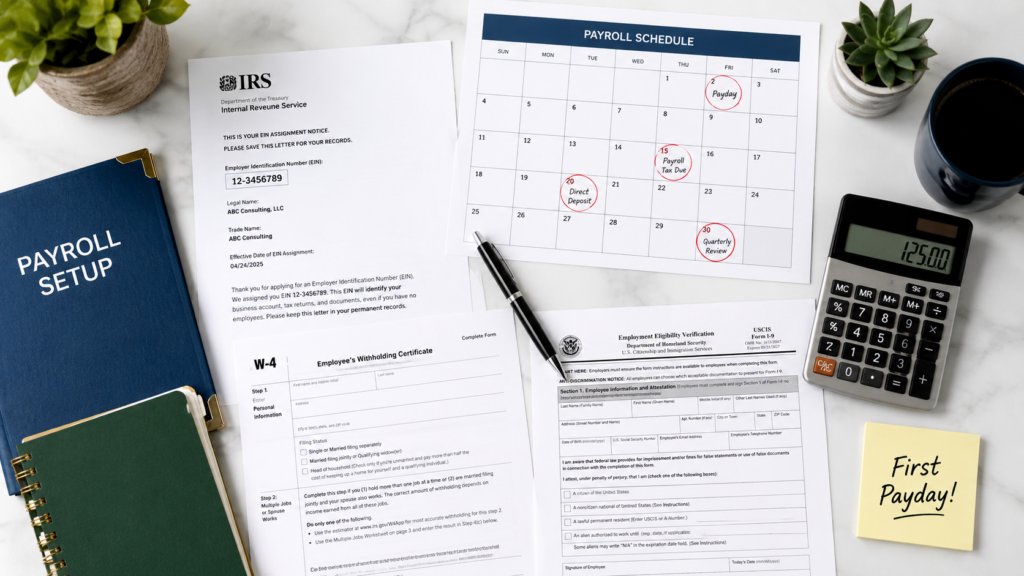
This is where payroll gets real. Your employer payroll obligations go well beyond just writing checks. Here’s what you’re on the hook for each pay period.
FICA Matching
Under the Federal Insurance Contributions Act, employers must match the employee’s Social Security and Medicare contributions. For every dollar of Social Security withheld from an employee’s paycheck, the employer pays an additional dollar from its own funds. The employer Social Security rate is 6.2% on wages up to $176,100 per employee per calendar year for 2025.
Medicare matching is 1.45% with no wage ceiling.
Additionally, if your employee earns more than $200,000 in taxable gross wages, they’re required to pay an additional 0.9% on wages over $200,000.
That one catches people off-guard.
FUTA and SUTA
Apply the 0.6% federal unemployment tax rate (FUTA) to the first $7,000 of each employee’s annual wages, after factoring in any state unemployment tax credits.
You’ll also owe state unemployment taxes (SUTA), with rates that vary by state and your claims history.
Tax Deposits and Filing
Employers must deposit all payroll taxes with the government by specific deadlines set by the IRS. The IRS requires employers to deposit all payroll taxes electronically, either through your business tax account, DirectPay for businesses, or the Electronic Federal Tax Payment System (EFTPS).
New employers start on a monthly deposit schedule.
As your payroll liability grows, that cadence can shift to semi-weekly.
File Form 941 each quarter (April 30, July 31, October 31, January 31) to report federal income tax, Social Security, and Medicare. File Form 940 annually by January 31 to report FUTA.
Step 6: Choose Your Pay Schedule
Weekly, biweekly, semimonthly, monthly which is right? The answer depends on three things: your state’s requirements, your cash flow patterns, and what your employees actually prefer.
Your state’s minimum pay frequency laws may require weekly pay for certain workers.
Employers should always check with their state’s department of labor before creating a payroll calendar.
Once you’ve picked a schedule, stick to it. Your employees count on consistency. Miss a payday and you’ll damage trust that takes far longer to rebuild than the problem took to create.
Step 7: Use a Payroll Compliance Checklist and the Right Software
Once your foundational pieces are in place, a solid payroll compliance checklist keeps every pay cycle clean. Here’s what to verify each run: hours tracked accurately, correct gross wages calculated, pre-tax deductions applied first (health premiums, HSA, 401k), taxes withheld per the W-4, net pay confirmed, and pay stubs issued.
On the software side, tools like QuickBooks Payroll simplify the process significantly.
QuickBooks Payroll’s Auto Payroll feature includes an AI tool that proactively collects employee attendance data for pay runs, sends alerts, and spots potential issues.
For QuickBooks payroll configuration, connect your EIN, link your payroll bank account, enter each employee’s W-4 data, and select your pay schedule the software handles the withholding math from there.
Using a cloud-based platform or payroll software makes your life easier by automating calculations, deductions, direct deposits, and tax filings, which greatly reduces errors and saves you valuable time.
Record-Keeping: Don’t Overlook This
Detailed and organized records of all pertinent payroll data must be stored securely for specific lengths of time in accordance with the federal Fair Labor Standards Act (FLSA) and state laws.
Keep detailed records of all hours worked, pay rates, payment history, and tax documents for all employees and contractors. You’re required to keep these records for at least three years.
Some states require longer checks.
FAQ: Small Business Payroll Setup
Q: How long does it take to set up payroll for a small business?
Setting up payroll requires seven essential steps: obtain an EIN, classify workers, collect tax forms, choose a pay schedule, select a payroll system, set up tax withholdings, and establish record-keeping. Most small businesses complete the entire setup process in 2–3 weeks with proper preparation.
Q: Do I really need a separate payroll bank account?
Yes and it’s one of the best habits you can build as a new employer.
Some employers opt to open a payroll bank account, separate from their business account, to pay employees and fulfill tax obligations.
It makes audits cleaner and your bookkeeping far less painful.
Q: What happens if I make payroll tax mistakes?
As an employer, you’re responsible to ensure that tax returns are filed and deposits and payments are made, even if you contract with a third party to perform these acts. You remain responsible if the third party fails to perform any required action.
Penalties for late deposits and misfiled returns add up fast which is exactly why getting your setup right from day one isn’t optional.
A small business payroll setup doesn’t have to be the thing that keeps you up at night. Get your EIN, open a dedicated payroll account, classify your workers carefully, collect your new-hire forms, understand your employer payroll obligations, and choose payroll software that handles the heavy lifting. Do those things right, and every payday after that is just a rhythm you repeat.
Ready to take the next step? Download our free payroll compliance checklist and walk into your first pay run with total confidence, no scrambling, no penalties, no stress. Contact Gina Webb for a free no obligation consultation.