
So you opened your mailbox, and there it was an envelope from the Internal Revenue Service. Your stomach dropped. Your coffee suddenly tasted worse. I get it. That little white envelope might as well come with its own dramatic soundtrack.
But here’s the thing: receiving an IRS notice is not the catastrophe it feels like in that initial moment. If you’ve received an IRS notice and don’t know what to do next, this guide will walk you through every step calmly, clearly, and without the panic spiral.
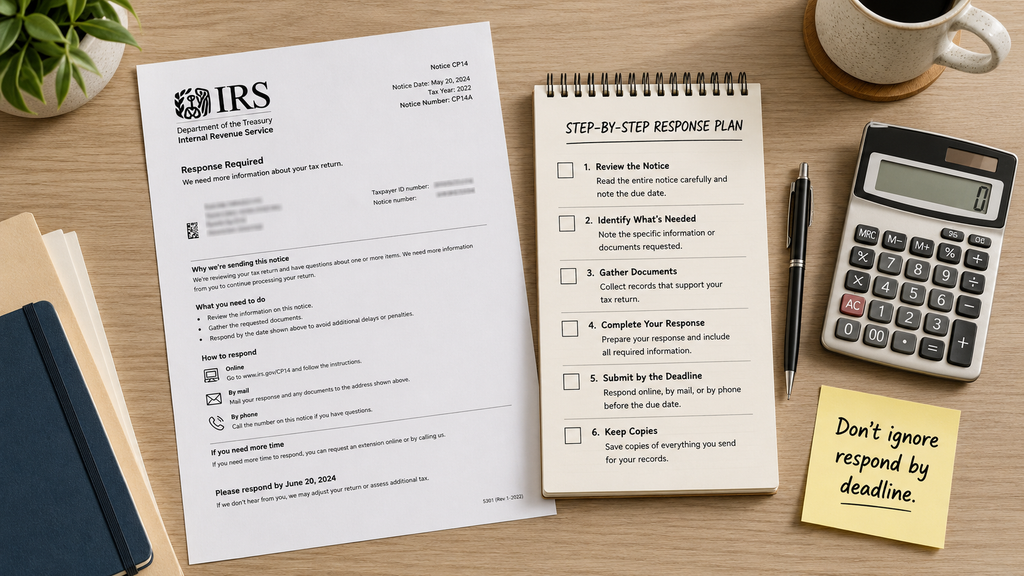
Don’t ignore it, don’t panic. Find the notice number (top-right corner), read it carefully, note the deadline, gather your documents, and respond in writing by the deadline. If it’s complex or involves an audit, get professional help.
Why the IRS Sends Notices (It’s Usually Not That Dramatic)
There are a variety of reasons the IRS may send a formal notice or letter via mail.
And honestly? Most of them are pretty mundane.
Typically, there’s no need to worry they may just be reminding you of a balance due or asking for more information.
Think of it like a parking authority sending a letter. Sometimes it’s a ticket. Sometimes it’s just a reminder. Either way, you have to open it and deal with it. The worst thing you can do is toss it on the “I’ll deal with it later” pile because with the IRS, “later” has a way of becoming “uh oh.”
IRS letters are rarely random and typically signal a need for information, payment, or corrective action.
So let’s figure out which one you’re dealing with.
Step 1: Find the Notice Number and Read It Carefully
Before you do anything else, flip to the top-right corner of the letter.
Start by locating the notice number (found in the upper right corner, beginning with “CP” or “LTR”), the tax year in question, and the response deadline.
That code is your Rosetta Stone.
Every IRS letter or notice has an identifier in the top-right corner CP14, CP504, LT11, Letter 1058, CP90, or a four-digit number like Letter 3219. That code tells you exactly what the IRS is asking for and how much time you have.
Here’s a quick cheat sheet of common ones:
CP14 is a first balance-due notice with no immediate consequence beyond interest and penalties accruing. CP504 is a final notice before levy. LT11/Letter 1058 starts the 30-day clock for Collection Due Process rights. CP3219A is the 90-day Statutory Notice of Deficiency.
Not sure what yours means?
The IRS maintains a searchable directory of notices and letters, where you can look up your specific notice number to confirm its meaning and the required action.
Using it’s surprisingly helpful.
Step 2: Check If It’s Actually Legit
This one’s important and easy to overlook.
There are scammers who claim to be from the IRS. They send fraudulent letters requesting personal or financial information and often threaten recipients with legal action or jail time if they don’t respond at once.
Real IRS notices don’t demand gift cards. They don’t call you on the phone first or email you threatening your arrest.
If a notice seems suspicious to you, trust your instincts. Contact the IRS to verify whether the notice is legitimate or not.
Step 3: Mark the Deadline Immediately
This is where I can’t stress enough: deadlines matter enormously here.
The IRS notice deadline may appear in more than one place in the letter, and missing it can limit your appeal rights, increase penalties, or trigger automated collections.
Calendar the response date immediately. Save the envelope if timing may later be disputed, and note whether the letter requires mailing, faxing, or an online response.
Also, keep in mind: to guarantee your appeal rights, reply by the due date. Even if you can’t pay the full amount you owe, pay by the due date this can reduce interest and penalty charges.
Step 4: Understand What the IRS Is Actually Questioning
Now that you know your notice type and deadline, it’s time to compare.
Compare the information in the notice or letter with your return. If you agree, note the corrections on your personal copy of the tax return and keep it for your records.
Before drafting an IRS notice response letter, determine whether the notice points to an audit, a collections action, a missing return, or a proposed assessment. Each requires a different approach.
This is the step that most people rush and they really shouldn’t. Take your time here. Pull out your original return, your W-2s, your 1099s. Treat it like you’re fact-checking someone who may or may not have made a mistake because sometimes, the IRS does make mistakes.
A Closer Look: The IRS CP2000 Notice
One of the most common notices people receive is the IRS CP2000 notice.
IRS Notice CP2000 is not an audit or a bill, it is a proposed adjustment based on income mismatches between your tax return and third-party reporting (W-2s, 1099s, brokerage forms).
In other words, your employer, bank, or brokerage told the IRS one number, and your return told the IRS a different number. Classic case of crossed wires.
Common causes include forgotten 1099s, misreported stock cost basis, late-arriving corrected W-2s, income misattributed to your Social Security number, or simply a missed form.
Here’s the good news: you can dispute both the tax and the penalties (commonly a 20% accuracy penalty), and even if you agree with the proposed tax change, you can still contest the penalty separately.
That’s worth knowing before you just sign on the dotted line.
You have 30 days to respond, and silence is treated as agreement.
So don’t go quiet.
Step 5: Respond to Your IRS Letter In Writing
Now it’s time to actually respond to the IRS letter. How you do this depends on whether you agree or disagree with what the notice says.
If you agree:
Complete, sign, and date the response form (both spouses’ signatures if you filed married filing jointly) and return it using the IRS Document Upload Tool, faxing, or mailing it to the location or address listed on the notice by the due date.
If you disagree:
Provide a written explanation and supporting documentation such as corrected 1099s or brokerage cost basis statements to reduce or eliminate the proposed amount.
If you can’t pay in full: Don’t disappear.
If you agree with the balance but can’t pay, don’t ignore the notice. Apply for an Installment Agreement at irs.gov/payments or request Currently Not Collectible status by submitting Form 433-F with documentation of monthly income and allowable expenses.
And always always; use certified mail with return receipt, as the IRS regularly loses correspondence and your CMRR is the only proof of timely filing.
Consider it your receipt for peace of mind.
Step 6: Know When to Call in IRS Audit Representation
Some notices are straightforward. Others are not. If your notice involves an audit, a significant proposed assessment, or collection enforcement, it may be time to bring in professional backup otherwise known as IRS audit representation.
The IRS allows taxpayers to have a tax attorney, CPA, or enrolled agent handle all communications.
This isn’t admitting defeat. It’s being smart. Think of it like hiring a contractor to rewire your house technically you *could* try it yourself, but some situations really call for someone who does it every day.
Keep copies of the notice, your response, proof of submission, and proof of payment.
Whether you handle this yourself or with a pro, documentation is everything.
FAQ: Received an IRS Notice? Here Are Your Top Questions Answered
Q: What’s the first thing I should do when I receive an IRS notice?
Don’t panic, and don’t ignore it. Find the notice number in the top-right corner of the letter, identify the tax year involved, and locate the response deadline. Then use the IRS’s online notice directory to understand exactly what you’re dealing with before taking any action.
Q: What if I can’t afford to pay what the IRS says I owe?
You can request an installment agreement if you can’t pay the full amount this way, you can repay your debt over time without too much stress.
You can also explore Currently Not Collectible status if your financial situation is severe. The key is to still respond by the deadline, even if you can’t pay in full.
Q: Is a CP2000 notice the same as an audit?
Nope and this is a really common misconception.
A CP2000 notice is generated automatically by the IRS when the income reported on your tax return does not match information submitted by third parties such as employers, banks, or brokerage firms. It is not an audit, and in many cases it is triggered by a simple clerical error or missing form.
Don’t Let That Envelope Win
Look, getting an IRS notice isn’t anyone’s idea of a good Tuesday. But it’s also not the end of the world. The process is manageable especially when you know the steps. Read the notice, find the number, mark the deadline, gather your documents, and respond. That’s really the whole game.
And if things feel over your head, that’s what tax professionals are for. Getting expert tax notice help isn’t a sign of weakness, it’s a sign that you’ve got good judgment.
The worst move? Doing nothing.
The IRS treats silence as agreement with their position.
And that’s one agreement you definitely don’t want to make by accident.
Ready to tackle your IRS notice with confidence? Contact Gina Webb for a free consultation. We’ll help you understand your notice, protect your rights, and figure out the best path forward. You’ve got this, and so do we.