
Running a small business without cash flow forecasting is a bit like driving at night with your headlights off. You might know the road, but you won’t see the pothole until it’s too late. Cash flow forecasting for small businesses isn’t a “nice to have” it’s the difference between staying open and shutting down.
I’ve seen it happen to great businesses with great products. The problem wasn’t the idea. It was the money running out.
- Cash flow forecasting predicts when money enters and leaves your business
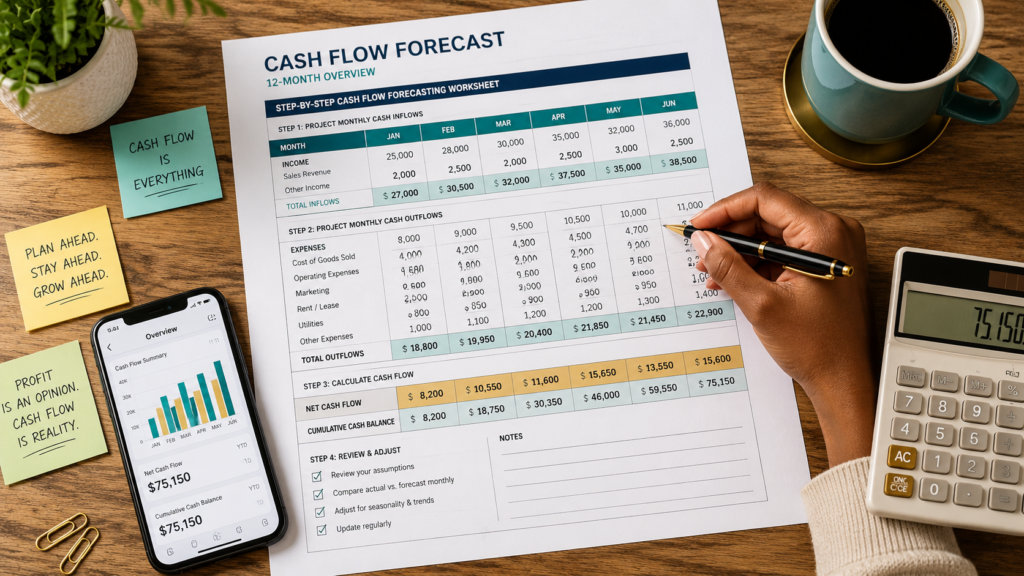
- Build your forecast by listing all inflows, then all outflows, then calculating your net position monthly
- Use conservative estimates plan for the worst, celebrate the best
- Update your forecast regularly; it’s a living document, not a filing cabinet trophy
- Short-term forecasting (1–13 weeks) handles daily survival; medium-term (3–12 months) handles growth planning
Why Cash Flow Forecasting for Small Businesses Is Non-Negotiable
Let’s start with some uncomfortable data.
82% of small businesses fail due to poor cash flow management.
And the really painful part? Most of those failures weren’t inevitable.
88% of small businesses report experiencing cash flow disruptions in the past year, yet fewer than one-third take proactive steps to prevent them.
That’s a staggering gap between knowing there’s a problem and actually doing something about it.
Here’s the thing people miss: being profitable and having cash aren’t the same thing.
While entrepreneurs obsess over profit margins and market share, they often overlook the most fundamental truth of business survival: profitability and cash flow are not synonymous. A company can be profitable on paper while drowning in a liquidity desert.
70% of small businesses have less than four months of operating cash, and for most, operating expenses consume 90% of their revenue.
That’s almost no margin for error. A monthly cash flow projection gives you the visibility to see trouble coming and enough runway to steer around it.
What Is a Cash Flow Forecast, Exactly?
Before we get into the steps, let’s get the definition locked in.
A cash flow forecast is a financial plan that predicts how much money your business will have at specific future dates by estimating incoming and outgoing cash. It shows your expected cash position so you can plan spending, avoid shortfalls, and make informed decisions about growth.
Notice what that definition doesn’t say. It doesn’t say “profit plan.” It doesn’t say “budget.”
Unlike budgeting, which focuses on planned income and expenditures for a fixed period, cash flow forecasting emphasizes the timing of actual cash movements. While budgets show what you plan to earn and spend, cash flow forecasts reveal *when* those transactions will occur.
Timing. That’s the secret weapon here.
Short-Term vs. Medium-Term Forecasting
Choose forecasting periods that match your goals: short-term forecasts (up to three months) for daily cash management, medium-term (three to 12 months) for annual planning, and long-term (one to five years) for expansion or financing decisions.
For most small businesses, I recommend starting with a 13-week short-term forecast and a rolling 12-month medium-term view. Run them simultaneously. One keeps the lights on; the other tells you where you’re going.
Step-by-Step: How to Build Your Monthly Cash Flow Projection
Step 1: Pull Your Historical Data
Don’t guess.
Before you start projecting future cash flows, it’s essential to have a clear understanding of your historical cash flow patterns. Thoroughly review your past income statements, balance sheets, and cash flow statements to gain insights into your company’s revenue, expenses, and working capital trends. This information serves as a baseline for future projections and helps identify patterns and potential anomalies.
Pull at least 12 months of data. More is better. Look for seasonal dips, slow-pay clients, and recurring expense spikes. Your past is the most honest forecaster you’ve got.
Step 2: Map Out All Your Cash Inflows
List every source of money coming in. Product sales, service revenue, deposits, loan draws, tax refunds all of it. Be specific about timing. A contract signed in June doesn’t mean cash in June if your terms are net-60.
Factor future uncertain events into forecasts after weighing their probability. For example, if you’re 70% sure a client will renew their contract, include 70% of that expected revenue in your forecasts rather than all-or-nothing.
That’s smart, realistic revenue vs. expenses planning not wishful thinking.
Step 3: Map Out All Your Cash Outflows
This is where small business owners often get sloppy. Fixed costs are easy rent, salaries, software subscriptions. Variable and irregular costs trip people up. Think: quarterly tax payments, annual insurance premiums, equipment repairs, and that supplier invoice you keep forgetting about.
In terms of predictability, taxes are inevitable, payroll costs usually rise over time, and loan obligations depend on your capital needs.
Get them all in the spreadsheet.
Step 4: Calculate Your Net Cash Flow
Simple math. Total inflows minus total outflows equals your net cash flow for the period.
Subtracting total outflows from total cash inflows gives the net cash flow for each period in the forecast. Add this to the opening cash balance to determine the projected cash balance at the end of each period.
If that number is negative, you’ve just discovered a future cash shortfall *before* it happens. That’s exactly the point.
Step 5: Run Best-Case and Worst-Case Scenarios
One forecast version is good. Three forecast versions is better.
Create two additional versions of your spreadsheet to test different scenarios: a best-case scenario where sales exceed projections or a new client signs on, and a worst-case scenario where a major client delays payment or costs rise unexpectedly. These scenarios help you see how much wiggle room you have and where you might need extra funding or cost-cutting.
Think of it like packing an umbrella. You hope you won’t need it. But you really don’t want to be caught in a downpour without one.
How to Avoid Cash Shortfalls: The Rules I Live By
Always Use Conservative Estimates
One of the cardinal rules of cash flow forecasting is to be conservative in your estimates. It’s better to underestimate your incoming cash and overestimate your expenses. This conservative approach ensures that you’re prepared for unexpected downturns and have a financial cushion to fall back on.
If your actual results come in better than projected, fantastic. That’s a Tuesday you’ll actually enjoy.
Account for Late Payments
Late payments are not the exception; they’re practically the rule.
A QuickBooks survey found that 56% of small businesses are waiting on cash from unpaid invoices and almost half were 30-plus days overdue.
Build this delay into your inflow timing. If a client is chronically 15 days late, stop forecasting them as on-time.
Keep Updating Your Forecast
Cash flow forecasting is not a one-and-done task. It’s an ongoing process that requires constant monitoring and regular updates. As your business evolves, your cash flow projections should reflect these changes. Compare your forecasts to real-world results, identify variances, and adjust your projections accordingly.
Regular reviews monthly for short-term, quarterly for long-term help maintain agility in your financial planning.
Tools That Make Short-Term Financial Forecasting Easier
You don’t need a finance degree or an army of analysts. But you probably do need better tools than a 2012 spreadsheet you found on Google Drive.
Accounting software with automatic bank feeds and real-time data reduces manual errors and keeps your forecast current, so you can focus on making decisions instead of updating spreadsheets.
And if you’re still doing it all manually, consider this: nearly 88% of spreadsheets have significant errors in them. More shocking? The majority of them are human errors meaning they could have been completely avoidable mistakes.
Tools like QuickBooks, Xero, or dedicated cash flow platforms connect directly to your bank accounts and accounting systems.
They pull real-time data, flag gaps. They save you from yourself on a Friday afternoon when you’re tired and just want to go home.
Frequently Asked Questions
Q: How far ahead should I forecast my cash flow?
It depends on your goal.
Cash flow forecasting best practices start with differentiating between your long-term and short-term cash issues. Short-term forecasting is about the cash flow to and from your business over the next few weeks, up to a maximum of six months.
For operational stability, a 13-week rolling forecast is the gold standard. Layer a 12-month view on top for strategic planning.
Q: What’s the difference between a cash flow forecast and a budget?
Your budget tells you what you *plan* to earn and spend. Your cash flow forecast tells you *when* that money actually moves.
Even a profitable business can face serious challenges if it runs out of cash due to payment delays or poorly timed investments.
The forecast accounts for that timing gap. The budget doesn’t.
Q: How do I forecast cash flow if my revenue is irregular?
Use probability weighting, historical averages, and scenario planning.
Base your estimates on market research, historical sales data, and any relevant industry trends. Consider factors like seasonality, economic conditions, and competitive landscape.
For truly unpredictable revenue, build a conservative base case that assumes slower collection, and keep a cash reserve to cover the gaps.
Cash flow forecasting for small businesses isn’t glamorous work. It’s not the part of entrepreneurship anyone puts on a motivational poster. But it is the single most effective thing you can do to keep your business alive long enough to hit the goals you actually care about.
Managing and predicting cash flow gives you more insight into where your business stands financially today and in the future. This allows for better-informed decisions regarding operations and investments, as well as growth opportunities. It also means you’re less likely to face a cash crunch and better able to handle unforeseen challenges.
Build the forecast. Keep it updated. Trust the numbers over the gut feeling at least when the gut is feeling overly optimistic.
Ready to take control of your cash flow? Let Gina Webb help you connect your accounting software, and run your first 13-week forecast. Your future self, the one who didn’t miss payroll will thank you.