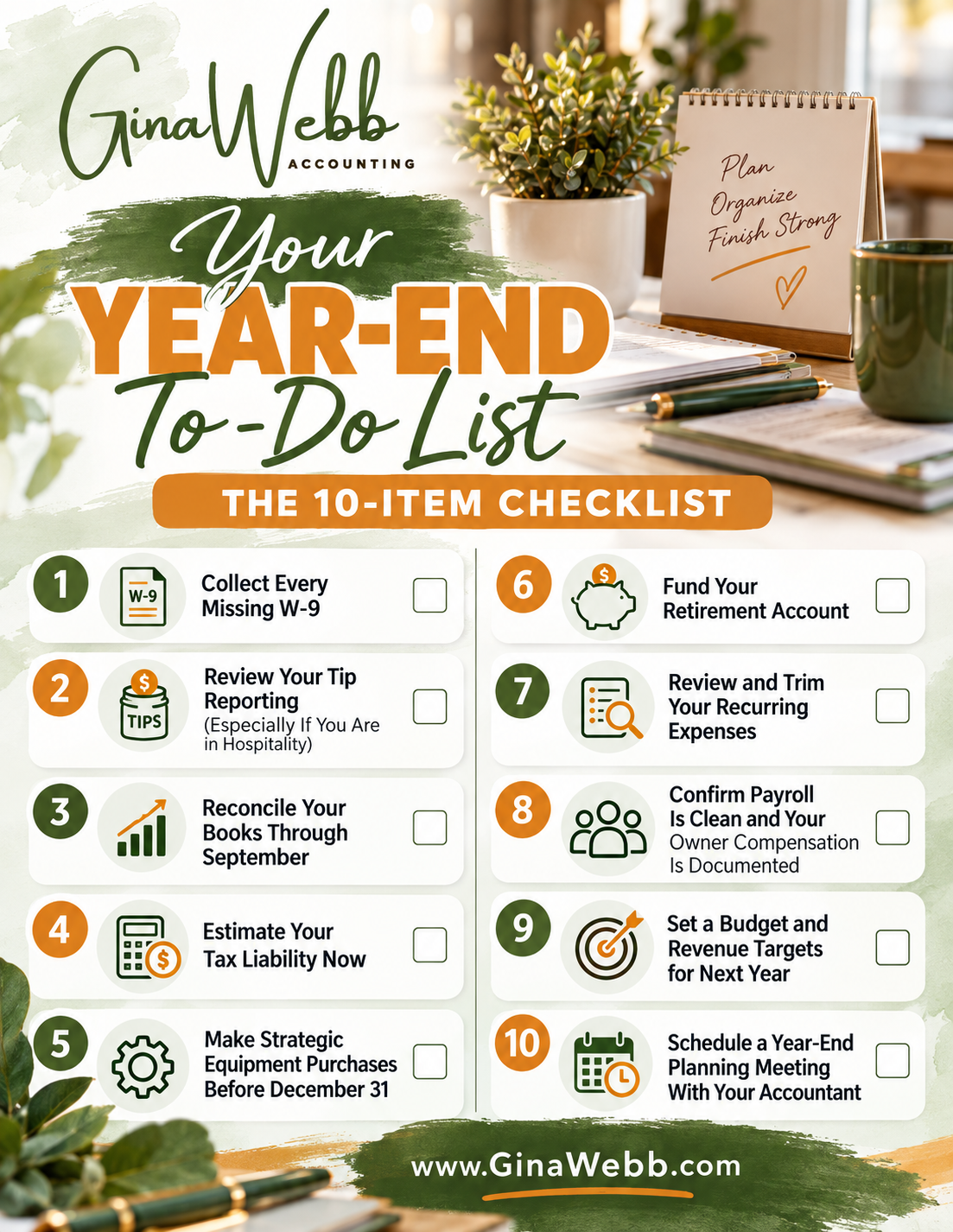
A short window sits between now and the end of the year and the business owners who use it well arrive at tax season calm, organized, and positioned to keep more of what they earned. This checklist gives you 10 concrete actions to complete before November, so you are not scrambling in December or making reactive decisions in January.
Why “Before November” Not “Before December 31”?
Most year-end content tells you to act before December 31. That is technically true, but it leaves you almost no room. Equipment needs to be ordered, delivered, and placed in service. Contractors need time to respond to W-9 requests. Your accountant’s calendar fills up fast. November is the last realistic month to make meaningful moves with enough runway to execute them properly.
Think of this list as your Q4 financial runway checklist not a last-minute panic drill.
The 10-Item Checklist
1. Collect Every Missing W-9
If you paid any contractor, freelancer, or vendor $600 or more this year, you will need to issue them a Form 1099-NEC by January 31. The information that goes on that form comes from a W-9. If you are missing even one, now is the time to chase it down, not in January when everyone is scrambling.
Make it a habit: request a W-9 before you issue the first check to any new contractor. For existing contractors, confirm that the name, address, and taxpayer ID on file are still current and accurate. A mismatch triggers IRS backup withholding headaches that are entirely avoidable.
2. Review Your Tip Reporting (Especially If You Are in Hospitality)
Las Vegas is a tip-heavy economy restaurants, bars, salons, hotels, and service businesses all deal with this. Here is what employers need to keep straight:
Employees who receive $20 or more in tips in any calendar month are required to report those tips to you by the 10th of the following month. You in turn are required to withhold federal income tax and both the employee and employer portions of FICA taxes on reported tips. Tips are taxable compensation not off-the-books income.
If you operate a food or beverage establishment with more than 10 employees, you are also required to file IRS Form 8027 annually, and you may face tip allocation requirements if reported tips fall below 8% of gross receipts.
Year-end is the right time to audit your tip tracking system: Are your employees submitting monthly tip reports? Are you running those tips through payroll correctly? Is your POS generating the records you would need in an audit? Cleaning this up now protects both you and your team.
3. Reconcile Your Books Through September
You cannot make smart decisions from bad data. Before you do any year-end tax planning, make sure your books are current and reconcile every bank account, every credit card, every loan. Pull a profit and loss statement for the year-to-date and a balance sheet as of September 30. This gives you a realistic picture of where you stand and lets you plan the next three months strategically rather than reactively.
If your bookkeeping is months behind, this is the item to address first; everything else on this list depends on clean numbers.
4. Estimate Your Tax Liability Now
With three months of actual data still to come, October is the sweet spot for running a tax projection. You have nine months of real numbers, which means your estimate can be meaningful rather than a guess.
The goal is to avoid two things: an ugly surprise bill in April, and an underpayment penalty from the IRS for not paying enough throughout the year. If your Q4 estimated tax payment (due January 15) needs to be adjusted based on where your income is tracking, you want to know that in October not in February.

5. Make Strategic Equipment Purchases Before December 31
Thanks to the One Big Beautiful Bill Act signed in 2025, 100% bonus depreciation is back meaning qualifying business assets placed in service after January 19, 2025 can be fully deducted in the year of purchase rather than spread over years of depreciation schedules. Section 179 was also expanded, raising the maximum deduction to $2.5 million for 2025 with a phase-out threshold that begins at $4 million.
For most Las Vegas small business owners, this means: if you need new equipment, computers, furniture, or qualifying software, buying it before December 31 and putting it to use gives you a full deduction this year. The key word is “placed in service” the asset must be operational, not just ordered and sitting in a box.
November is realistically your last month to order significant equipment and still get it installed and operational by December 31.
6. Fund Your Retirement Account
Contributing to a SEP IRA, SIMPLE IRA, or solo 401(k) before year-end is one of the cleanest ways to reduce taxable income available to small business owners. Some plan types allow contributions up to the tax filing deadline, but others particularly SIMPLE IRAs require the plan to be established earlier in the year. Check with your advisor on which applies to your situation, and confirm you are contributing as much as your cash flow allows.
7. Review and Trim Your Recurring Expenses
Year-end is a natural audit point. Pull up your subscriptions, software licenses, service contracts, and vendor agreements. How many of them are you actually using? Canceling unused subscriptions before they auto-renew in January is money directly back in your pocket. And if you are on cash-basis accounting, prepaying legitimate January expenses like rent or insurance premiums before December 31 lets you deduct them this tax year.
8. Confirm Payroll Is Clean and Your Owner Compensation Is Documented
If you operate as an S-Corp, your salary needs to be reasonable and well-documented before year-end. The IRS pays attention to S-Corp owner compensation, and underpaying yourself a salary to avoid payroll taxes is a known audit trigger. Confirm your W-2 amounts are correct, your payroll tax deposits are current, and any year-end bonuses are scheduled and processed properly through payroll not paid informally.
For any employees, verify addresses are current so W-2s go to the right place. A small thing that causes January chaos if overlooked.
9. Set a Budget and Revenue Targets for Next Year
Year-end is not only about closing the books on this year, it is the best moment to plan the next one. Once you have a clear picture of your current-year profit and loss, set a written budget for next year. Even a simple one. What are your fixed costs? Where do you want to grow revenue? What investments are you planning? Having numbers on paper before January gives you something to manage, rather than starting the new year flying blind.
10. Schedule a Year-End Planning Meeting With Your Accountant
This is the most important item on the list, and the one most likely to get pushed. Do not wait until your accountant’s schedule is slammed in December or January. A year-end planning meeting in October or early November when there is still time to act on the advice is categorically more valuable than a tax preparation meeting in March when the year is already over.
Bring your reconciled books, your tax projection, and a list of any major changes from this year: new employees, new equipment, a business structure change, a new service line, a big contract. Your accountant can only plan around what they know.
FAQ
What is the deadline for sending out 1099-NEC forms?
The deadline for filing Form 1099-NEC with the IRS and providing copies to contractors is January 31. That deadline makes collecting W-9s now before the end-of-year rush a practical necessity rather than optional housekeeping.
Do Las Vegas restaurant and hospitality businesses have special tip reporting rules?
Yes. Food and beverage establishments with more than 10 employees are required to file IRS Form 8027 annually and may be subject to tip allocation requirements if total reported tips fall below 8% of gross receipts. Beyond that, all employers must run reported tips through payroll, withhold income and FICA taxes, and pay the employer share of Social Security and Medicare taxes on those tips.
How does bonus depreciation work for 2025?
Under the One Big Beautiful Bill Act, 100% bonus depreciation was reinstated for qualifying property placed in service after January 19, 2025. This means most business equipment, furniture, computers, and qualifying software can be fully deducted in the year of purchase rather than depreciated over multiple years. Section 179 was also expanded to a $2.5 million deduction limit with a $4 million phase-out threshold for 2025.
When should I meet with my accountant for year-end planning?
October or early November is ideal. Meeting while you still have time to implement strategies, equipment purchases, retirement contributions, payroll adjustments is far more valuable than meeting in tax season when the year is already closed.
Is Nevada a good state for small business taxes?
Generally yes. Nevada has no state corporate income tax, no personal income tax, and no franchise tax on most small businesses. The Modified Business Tax only applies to employers with payroll above certain thresholds, and the Commerce Tax only kicks in for businesses with gross revenue above $4 million. For most small business owners in Las Vegas, the state tax picture is relatively favorable which makes managing the federal side even more important.
Take the Next Step Before the Window Closes
The businesses that show up to tax season calm and prepared are not luckier; they just started earlier. Download this checklist and pin it somewhere visible, then take one action today: whether that is requesting a missing W-9, opening your books for a reconciliation review, or simply reaching out to schedule time with Gina.
Download this checklist now and then schedule a no-obligation consultation with Gina today. Ten items, a few focused weeks, and a much smoother path to January.