
Picture this: it’s mid-April, you’re sitting at your kitchen table surrounded by receipts, and your accountant just sent you a message that reads “we need to talk about your business structure.” Not the vibe you were going for. I’ve been there, and I promise it’s less dramatic than it sounds but choosing between a Nevada LLC and a sole proprietorship really does have real, dollars-and-cents consequences at tax time.
So let’s sort it out together. No jargon, no panic.
Nevada LLC vs Sole Proprietorship Taxes at a Glance
- Both structures use pass-through taxation business income flows to your personal return
- Nevada has zero state income tax, so neither structure owes state-level income tax
- Sole proprietorships cost nothing to set up but offer no liability protection
- Nevada LLCs carry setup and annual fees but unlock tax flexibility, deductions, and protection
- Self-employment tax (15.3%) applies to both but an LLC can elect S-Corp status to reduce it
- Modified Business Tax (MBT) only applies if you have employees; most solo operators skip it entirely
- The verdict: For most growing businesses, the LLC wins on long-term tax strategy
How Nevada LLC Sole Proprietorship Taxes Actually Work
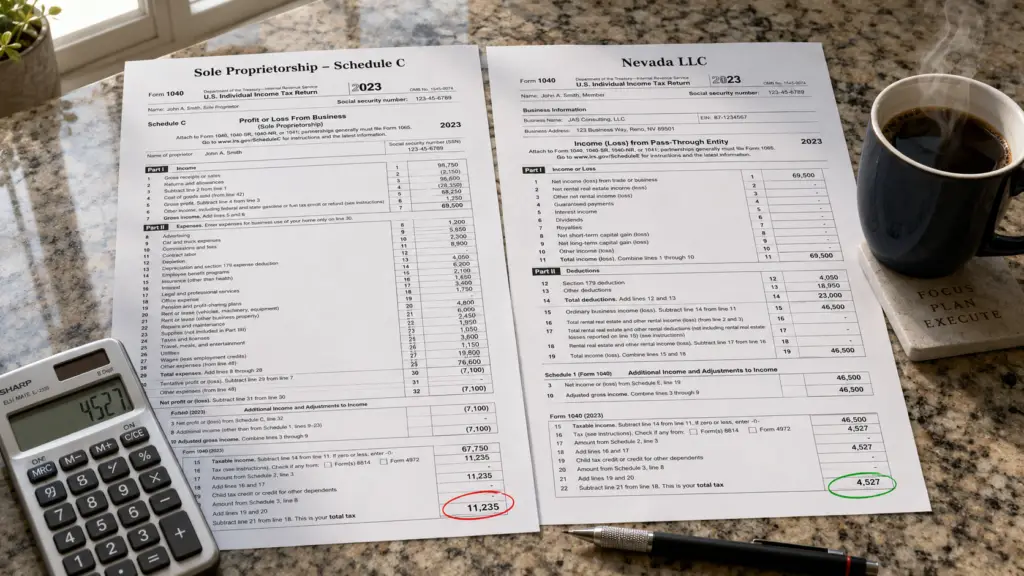
Here’s what surprises a lot of new business owners: both a sole proprietorship and a single-member LLC are pass-through entities, meaning taxes are directly passed to the owners and paid by them rather than by the business.
So far, they sound identical. And at a basic level, they kind of are until you look a little closer.
If your LLC has a single member who is an individual, the IRS will tax your LLC as a sole proprietorship.
The IRS calls this a “disregarded entity,” which sounds mildly insulting, but is actually excellent news.
The LLC itself doesn’t pay taxes and doesn’t have to file a tax return with the IRS. Instead, you pay taxes on the personal income you make as an LLC member.
For a multi-member LLC, things shift slightly.
A multi-member LLC can also pay taxes as a pass-through entity, but it must file a business tax return using Form 1065, and each member’s return should include a Schedule K-1 to show their share of company earnings.
Nevada’s Tax-Friendly Superpower
Nevada is one of those rare states that almost seems too good to be true for business owners.
Nevada doesn’t have a corporate income tax for businesses, and there’s no state income tax for individual wage earners; it’s one of only seven states in the U.S. that doesn’t impose a personal state income tax.
That means, for Nevada LLC sole proprietorship taxes, LLCs are treated as pass-through entities for federal tax purposes, and with no state personal income tax, LLC members don’t pay Nevada tax on their share of profits.
Same story for a sole proprietor. Nevada, in this sense, is generously indifferent to both structures.
But federal taxes? Those still apply.
Federal tax rates are between 10% and 37% depending upon the amount of income you make.
Nevada just stays out of your way while the IRS does what the IRS does.
The Self-Employment Tax Problem (And the LLC’s Secret Weapon)
Here’s where the structures start to genuinely diverge and where an LLC earns its annual fees.
Active LLC owners pay 15.3% self-employment tax on profits for Social Security and Medicare.
Sole proprietors face the exact same rate. So on this point, you’d think it’s a wash. And it is unless you make a smart election.
Electing S-Corp status via Form 2553 can cut self-employment taxes.
Here’s how it works in plain terms: as an S-Corp, you pay yourself a “reasonable salary” (which carries payroll taxes), and then take additional profits as distributions which are *not* subject to self-employment tax. For a business clearing $60,000+ in profit annually, this can mean thousands of dollars saved each year. A sole proprietor simply doesn’t have this option.
LLCs are the only type of business entity where the members can choose whether they’re taxed as a corporation or as a flow-through entity and that flexibility is genuinely worth something.
What Is the Nevada Modified Business Tax, and Do You Owe It?
The Modified Business Tax (MBT) gets mentioned a lot, and it causes unnecessary anxiety for solo operators. Let me clarify.
Nevada’s Modified Business Tax is an employer payroll tax on wages paid to Nevada employees. Rates are 1.17% for general businesses (on wages over $50K per quarter) and 1.554% for financial institutions and mining businesses. It’s filed quarterly.
The critical word there is *employees*.
The MBT is levied on employees’ gross wages minus any healthcare benefits provided by the employer, and employers who pay their workers more than $50,000 per business quarter are subject to it.
No employees? No MBT. It’s that simple. A solo LLC owner or sole proprietor operating without staff owes exactly zero dollars in Modified Business Tax. Nevada, bless its heart, keeps it light for single-operator businesses.
MBT is calculated on gross wages paid each quarter minus allowable deductions for employee health care benefits, and businesses may qualify for a 50% abatement during the first four years of operation if they meet eligibility requirements.
Nevada Business Structure Accounting Setup: What Each Costs
This is where the sole proprietorship looks attractive on the surface and where the LLC quietly makes a long-term argument.
Sole Proprietorship Setup Costs:
A sole proprietorship costs almost nothing to start. You might file a “doing business as” (DBA) name locally, but there’s no state registration, no EIN requirement (unless you hire), and no annual report.
Nevada LLC Setup Costs:
An LLC has real upfront costs.
Your LLC needs an annual report costing $200 for the state business license a yearly must to stay compliant.
You’ll also need to handle EIN registration in Nevada through the IRS (free, but required), and registered agent fees range from $0 if you’re your own agent to $300 per year for professionals.
But here’s the thing: Nevada doesn’t tax LLCs on state income, making it one of the top tax-friendly states for LLCs.
And Nevada doesn’t impose a franchise tax, something that saves LLC owners hundreds compared to states like California or Texas.
Nevada LLC owners can also write off certain expenses from their taxable income, including startup costs if you’ve just launched.
That’s a deduction a sole proprietor is equally entitled to, but the LLC structure often creates cleaner records to support those claims.
Commerce Tax: The One That Only Applies at Scale
If your LLC’s gross revenue tops $4 million, you’ll file a Commerce Tax return with the Nevada Department of Taxation. Rates range from 0.051% to 0.331% based on industry. Below $4 million? You’re exempt.
Most small businesses will never see this tax. It’s genuinely irrelevant until you’ve scaled considerably which is a nice problem to have.
So Which Structure Actually Costs Less at Tax Time?
Think of it like this: a sole proprietorship is the studio apartment of business structures cheap, easy, and perfectly fine until you need more space. An LLC is a slightly more expensive apartment with actual walls separating your business life from your personal life.
Sole proprietorships are particularly suitable for businesses with limited liability exposure, such as home-based businesses or those offering personal services. A sole proprietorship can be a practical choice if your business is small, easy to manage, and poses little legal risk.
But the sole proprietorship setup can start to have issues once the business starts to grow and scale up which is why LLCs are better options in the long run, since owners are protected from business liabilities and have more taxation options.
The honest answer: if you’re earning under $30,000 and just testing the waters, a sole proprietorship is fine. Once you’re growing, dealing with clients, or crossing into consistent profitability, the LLC’s tax flexibility, especially the S-Corp election will almost certainly outweigh its setup and maintenance costs.
FAQ: Nevada LLC vs Sole Proprietorship Taxes
Not really, by default.
Single-member LLCs are generally treated as “disregarded entities” for federal tax purposes; in other words, they’re considered part of their owners’ personal income tax returns.
Both use Schedule C.
Almost certainly not.
Nevada doesn’t impose a state income tax, but businesses with employees may be subject to the Modified Business Tax.
No employees, no MBT. It’s a payroll tax, not a profits tax.
Yes and this is one of the biggest tax advantages.
Active LLC owners pay 15.3% self-employment tax on profits for Social Security and Medicare, but electing S-Corp status can reduce this, and Nevada adds no extra self-employment tax on top.
The Bottom Line
Comparing Nevada LLC sole proprietorship taxes isn’t a one-size-fits-all equation. Both structures benefit from Nevada’s zero state income tax. But the LLC gives you a toolkit; the sole proprietorship simply doesn’t have liability protection, S-Corp election eligibility, cleaner deduction records, and genuine credibility with clients and lenders.
If you’re serious about your business (and if you’re reading a 1,500-word article about tax structures, I’m going to assume you are), the LLC is almost always the smarter long-term move. The annual fees are modest. The upside is substantial.
Ready to make the call? Talk to Gina today who can review your specific income level and industry then set up the structure that serves your bottom line for years to come.
*This article is for informational purposes only and does not constitute tax or legal advice. Please consult a qualified tax professional for guidance specific to your situation.*