
Starting a business is exciting. You’ve got the idea, the drive, and maybe a name you’ve been sitting on for months. But before you print a single business card, your business entity structure selection might be the most important decision you’ll make and most people treat it like an afterthought.
It shouldn’t be. The structure you choose affects your taxes, your personal liability, your ability to raise money, and how much paperwork fills your Sunday evenings for years to come.
Your business entity structure determines how you’re taxed, how your personal assets are protected, and how your business can grow. LLCs are flexible and beginner-friendly. S-Corps offer real tax savings for profitable businesses. C-Corps are built for venture funding. There’s no universal “best”; it depends on your income, goals, and growth plans. Always consult a tax professional or attorney before deciding.
Why Business Entity Structure Selection Actually Matters
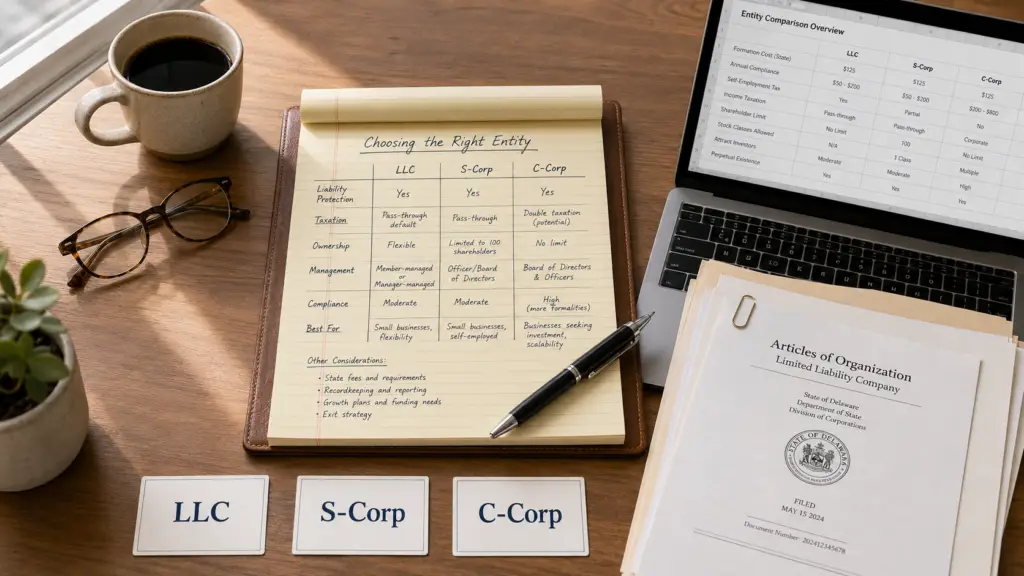
Think of choosing your entity like choosing a house. You can technically sleep in a tent (sole proprietorship), but when a storm rolls through a lawsuit, a debt, a tax audit you’ll wish you’d built something sturdier.
The entity type you choose affects fundamental aspects of doing business, such as the legal protection afforded to the owners, how business partners share in business income, and the tax burdens the business and owners will face.
And here’s the kicker: choosing the right structure protects personal assets from business liabilities and minimizes tax obligations but choosing the wrong one locks founders into rigid constraints and triggers unexpected costs.
Your business structure determines which income tax return form you file, so it’s critical to consider both legal and tax issues when selecting a business structure.
The Main Entity Types at a Glance
Before we go deep on the LLC vs S-Corp comparison, let’s quickly orient ourselves. The four main structures most small business owners consider are sole proprietorships, LLCs, S-Corps, and C-Corps.
If you start a business and skip the paperwork entirely, your company will operate as a sole proprietorship by default and in that situation, all the owner’s assets will be subject to unlimited liability of the business.
That’s a polite way of saying your house, car, and savings are on the table. Hard pass.
The three formal structures worth knowing are:
LLCs balance operational flexibility with liability protection, making them the default choice for many startups. S-Corps add tax efficiency for established businesses willing to navigate additional compliance requirements. C-Corps provide the sophisticated equity structures that venture capital and public markets demand.
LLC: The Flexible Starting Point
A limited liability company (LLC) combines the liability protection of a corporation with the simplicity of a sole proprietorship or partnership. Owners, called members, are safe from personal responsibility for most business debts and lawsuits, provided they maintain proper separation between personal and business finances.
It’s flexible too.
Members can manage the company directly, or they can appoint managers to oversee operations. Additionally, LLCs can choose how they want to be taxed: as a sole proprietorship (single-member LLC), partnership (multi-member LLC), or even elect corporate taxation.
On the tax side, an LLC’s default tax treatment is as a pass-through business, which means the LLC itself doesn’t pay federal income taxes profits and losses flow directly to the members, who report them on their tax returns. This avoids the double taxation that corporations incur, resulting in significant tax savings for small businesses.
But there’s a catch.
Members of an LLC are considered self-employed and must pay self-employment tax on their income, including Medicare and Social Security generally subject to the full self-employment tax rate of 15.3% when accounting for both the employer and employee portions.
So as your profits grow, that 15.3% becomes a meaningful number. That’s where the S-Corp starts looking very attractive.
S-Corp: The Tax-Saving Upgrade
What Is an S-Corp, Exactly?
An S corporation is not a standalone entity type but a special tax designation granted by the IRS. Eligible corporations and LLCs can elect to be taxed as an S-Corp, which allows profits and some losses to pass to shareholders’ personal tax returns, avoiding double taxation.
The Self-Employment Tax Advantage
Here’s where things get interesting for small business setup accounting.
S-Corp owners can strategically divide their income into two categories: compensation and distributions, a structure that directly reduces tax responsibilities. The salary portion is subject to payroll taxes, while distributions are not. This structure offers significant tax benefits for enterprises with high profits.
Real numbers help here.
This structure can lead to significant tax savings for businesses with steady profits. For example, if an S-Corp owner earns $80,000 as salary and receives $40,000 in distributions, only the salary is subject to payroll taxes potentially saving thousands annually.
Most tax professionals generally see S-Corp elections make sense when net business income exceeds $70,000–$100,000.
The Reasonable Salary Rule Don’t Skip This
The IRS isn’t naive.
The IRS requires that S-Corp owners pay themselves a reasonable salary based on their job duties, skills, and experience. The salary should be comparable to what other businesses pay for similar services. If the IRS determines that a shareholder-employee’s salary is unreasonably low, it may recharacterize some of the distributions as wages and impose penalties.
S-Corp Ownership Restrictions
S-Corps do come with guardrails.
An S-Corp must have 100 or fewer shareholders, all of whom must be U.S. citizens or residents, and only one class of stock is allowed.
For most small domestic businesses, this isn’t a problem. But if you’re planning global expansion or complex equity arrangements, take note.
LLC vs S-Corp Comparison: Side by Side
This is the question most entrepreneurs wrestle with. Here’s the honest answer: an LLC and an S-Corp are simply different ways a company can be taxed and the rules it needs to follow to stay compliant with the IRS. Neither option is “better” than the other the choice depends on the business type, size, and goals.
That said, there are clear differentiators.
LLCs can have an unlimited number of members, while S-Corps can have no more than 100 shareholders. Non-U.S. citizens and residents can be members of LLCs.
And when it comes to management,
LLCs are flexible; they can be member-managed or manager-managed while S-Corps require a board of directors, officers, and shareholder meetings.
A popular middle ground?
Many businesses opt for a hybrid approach: establishing an LLC for ease and legal protection and subsequently electing S-Corp taxation with the IRS. This enables you to preserve flexibility while reducing self-employment taxes.
C-Corp: When You’re Playing the Long Game
If you’re building the next venture-funded startup, the C-Corp deserves a serious look.
C-Corps benefit from a flat 21% tax rate which can be significantly lower than top individual income tax rates and can retain after-tax profits to fuel growth without passing income through to shareholders each year.
And for founders: under Section 1202, shareholders in certain C-Corps may be eligible to exclude up to 100% of capital gains on the sale of stock, offering significant benefits for founders and early investors.
The tradeoff?
C-Corps pay taxes on their profits, and shareholders pay taxes again when those profits are distributed as dividends commonly known as double taxation.
Incorporation Tax Benefits Worth Knowing
The QBI Deduction Now Permanent
Here’s a win for pass-through entity owners.
Both LLCs and S-Corps can qualify for the 20% qualified business income (QBI) deduction on pass-through income. The Section 199A deduction was made permanent under the One Big Beautiful Bill in July 2025.
That’s a meaningful deduction worth planning around talking to your accountant about maximizing it.
Compliance Costs Are Real
Incorporation tax benefits don’t come completely free.
The S-Corp requires more paperwork, but the tax savings often justify the extra complexity; some clients save $8,000–$15,000 annually, making the additional administrative burden a worthwhile investment.
How to Approach Small Business Setup Accounting for Your Entity
Whichever structure you choose, getting the accounting right from day one is non-negotiable.
All LLC revenue is considered personal income for the owner, which simplifies tax reporting and accounting but this structure requires meticulous record-keeping to ensure that every dollar of income and expenditure is accurately reported.
For S-Corps, the compliance bar is higher.
LLCs have fewer formalities with easier annual maintenance, while S-Corps involve more regulations, including shareholder meetings and strict IRS compliance.
Plan your accounting setup accordingly and seriously, hire a good CPA.
FAQ: Business Entity Structure Selection
Can I convert my LLC to an S-Corp later?
Yes, and it’s actually a common strategy.
You establish an LLC with your state, then submit IRS Form 2553 to elect S-Corp taxes, and commence disbursing a comparable compensation to yourself while submitting payroll tax documentation.
Just note that once you elect S-Corp status, you generally can’t revoke it for five years without IRS consent.
Which entity type is best for raising venture capital?
Venture capital firms typically prefer C-Corporations, not LLCs, due to equity structure, preferred stock, and potential Section 1202 Qualified Small Business Stock (QSBS) benefits. Complex ownership arrangements are more flexible in a C-Corp format when adding investors or issuing multiple classes of shares.
What’s the self-employment tax rate I should plan for as an LLC member in 2025?
For 2025, self-employment tax is 15.3% on income up to $176,100. As an LLC member, you pay self-employment tax on all business profits, whereas with S-Corp taxation, you only pay employment taxes on your salary, not on distributions.
Make the Right Choice Before You Need to Fix It
Business entity structure selection isn’t the sexiest part of starting a company. But it’s the foundation of everything else that sits on your taxes, your liability exposure, your ability to grow, and your accounting setup. Get it wrong early and you’ll spend far more fixing it later than you would have getting it right from the start.
The good news? You don’t have to figure this out alone. Whether you’re leaning toward an LLC for its simplicity, an S-Corp for its tax advantages, or a C-Corp for its investor appeal, a knowledgeable CPA or business attorney can help you map the right structure to your actual goals.
Ready to set up your business the right way? Let’s schedule a consultation today. I specialize in small business setup to choose the entity structure that fits your income, your goals, and your future, not just the one that sounds familiar.